
By: Cees van Versendaal, mWareTV
As competition in streaming intensifies, monetization strategies are evolving. While subscription models (SVOD) remain the cornerstone of most platforms, ad-supported video streaming is growing at the fastest rate. According to Statista, U.S. OTT TV and video revenue reached $74 billion in 2023, with forecasts predicting that figure will exceed $80 billion by 2029. Advertising is set to play a major role in that growth—provided it is done in a way that keeps both advertisers and viewers happy.
For years, streaming services have relied on two approaches: Client-Side Ad Insertion (CSAI) and Server-Side Ad Insertion (SSAI). Each has its advantages, but also significant drawbacks. Enter Server-Guided Ad Insertion (SGAI)—a hybrid technology that blends the best of both worlds, enabling seamless, scalable, and personalized advertising.
What Is Server-Guided Ad Insertion?
Server-Guided Ad Insertion (SGAI) is an advanced ad-insertion method where the server signals ad breaks, but the client-side video player handles the actual insertion and playback. This split responsibility allows for more efficient targeting, smoother transitions, and ad experiences that feel less disruptive to the viewer.
Here’s a Simple Breakdown of How it Works:
- Manifest Creation – The server generates a manifest containing SCTE-35 markers that define where and when ad breaks will occur.
- Ad Request – When playback reaches an ad break, the client device sends a personalized request to the ad server, including user-specific targeting data.
- Ad Playback – The video player fetches the right ad stream, inserts it seamlessly, and continues playback without interruptions.
The result: a system that is more personalized than SSAI, more scalable than CSAI, and better aligned with the needs of both advertisers and viewers.
CSAI vs. SSAI vs. SGAI
To understand the value of SGAI, it helps to compare it with the models it builds upon:
- Client-Side Ad Insertion (CSAI)
o Pros: Easy to implement, highly customizable, strong personalization.
o Cons: Vulnerable to ad blockers, inconsistent across platforms, and prone to jarring transitions.
- Server-Side Ad Insertion (SSAI)
o Pros: Resistant to ad blockers, scalable across platforms, ads stitched directly into the stream.
o Cons: Costly at scale, weaker personalization, less flexibility in adopting new ad formats.
- Server-Guided Ad Insertion (SGAI)
o Pros: Combines personalization with scalability, ensures seamless playback, and empowers new ad formats.
o Cons: Requires advanced player support, limited vendor availability, and evolving industry standards.
In other words, SGAI is a best-of-both-worlds approach, using the server for efficiency while letting the player optimize personalization and playback quality.
Why the Video Player Matters
SGAI fundamentally changes the role of the video player. No longer just the endpoint for content playback, the player becomes an orchestrator in the advertising workflow.
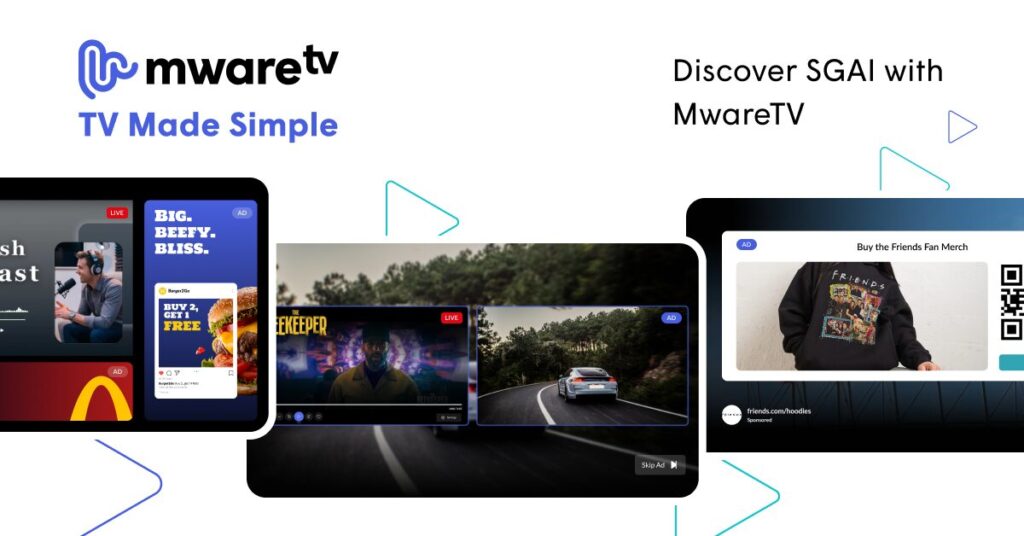
By analyzing user data, device conditions, and platform specifics, the player can choose the right ad format and insertion strategy in real time. This capability supports innovative ad experiences such as:
- L-shape (squeeze-back) ads
- Overlay ads
- Companion ads
- Double-box ads
These formats are particularly valuable for live events, where advertisers want visibility without interrupting the action. By balancing playback conditions, buffering, and break timing, the player ensures low latency and optimal ad delivery.
Benefits of SGAI
Streaming platforms exploring SGAI can expect a wide range of advantages:
- Scalability without risk: Manifests are not viewer-specific and can be cached by CDNs, making SGAI highly scalable.
- Guaranteed delivery: Ads are only requested when a break actually occurs, ensuring high fill rates and avoiding wasted inventory.
- Enhanced analytics: The player captures data on every ad break, enabling precise measurement of viewer behavior and ad performance.
- Low latency: Just-in-time ad requests make SGAI well-suited for live streaming where delays must be minimized.
- Better viewer experience: Personalized, seamless ads feel less intrusive and reduce churn risk.
- Agility in innovation: With no central “stitcher,” platforms can roll out new ad features faster.
- Cost efficiency: By reducing unnecessary ad requests, SGAI helps lower backend costs while improving inventory utilization.
Challenges of SGAI
Despite its promise, SGAI is still an emerging technology with hurdles to overcome:
- Limited vendor support: Fewer ad-tech providers currently support SGAI compared to SSAI or CSAI.
- Player dependency: Only advanced commercial players, such as Dolby’s THEOplayer, support SGAI today. Native and open-source players lag behind.
- Lack of standardization: With no industry-wide definition, implementations may vary and lead to compatibility challenges.
These issues are being addressed as adoption grows, but they highlight why SGAI is not yet universally deployed.
Dolby’s SGAI Solution
Dolby has been a leader in pushing SGAI forward and now MwareTV offers a fully integrated SGAI service for both live and on-demand content. The system ensures seamless ad placement, while also enabling interactive formats such as clickable ads and QR code integrations that deepen viewer engagement.
The performance gains are significant. According to Dolby, SGAI delivers measurable improvements compared to traditional SSAI:
- 76% uplift in eCPM, reflecting stronger revenue per 1,000 impressions.
- 132% higher fill rates, meaning more ad opportunities are monetized.
- 40% improvement in programmatic match rate, ensuring ads are better aligned with inventory.
- 86% viewability tracking accuracy, giving advertisers confidence their ads are being seen.
- 50% fewer ad requests, lowering backend costs and increasing efficiency.
These results underscore SGAI’s potential to transform OTT ad performance and set new standards for both monetization and viewer experience.
The Road Ahead
The OTT industry is at a crossroads. As audiences grow more resistant to disruptive advertising, platforms must deliver ads that feel relevant, seamless, and engaging. SGAI provides a way forward, offering the personalization of CSAI, the scalability of SSAI, and the flexibility to support new ad formats.
Though adoption is still in its early stages, the momentum is clear. As vendors expand support and standards emerge, Server-Guided Ad Insertion has the potential to redefine how advertising fits into streaming—ensuring that ads remain both profitable for platforms and palatable for audiences.

About Cees van Versendaal
Cees van Versendaal is the Chief Operating Officer of MwareTV, where he leads strategy and operations for the company’s OTT and streaming media solutions. With extensive experience across technology and media, including leadership roles at Philips Electronics and other international firms, he has a strong background in scaling digital platforms and driving innovation in video delivery.