
by: Lawrence Harte, Editor, iMarketing Magazine
Companies want to get qualified sales leads faster and at lower cost. Unfortunately, traditional marketing and sales processes are not working as well. People use caller ID to avoid sales calls, emails from unknown people go into the email SPAM bin and creating high-value content such as white papers, guides and other media can be costly and take a long time to create. A great solution is to do pre-content marketing.
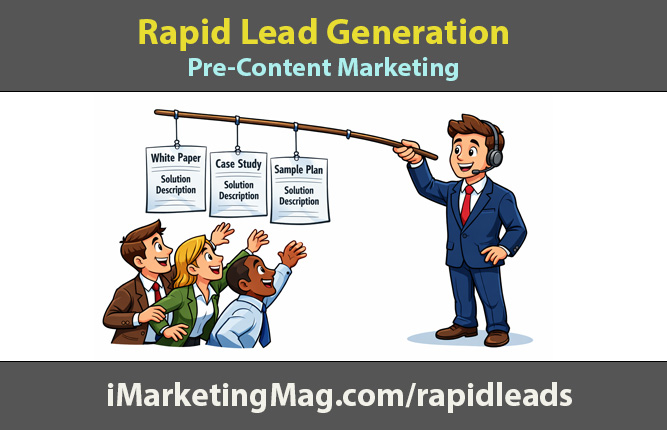
Pre-content marketing uses descriptions of future high-value content to attract and motivate qualified and interested prospects to submit their contact information. This can be descriptions of white papers (early stage sales), case studies (sales justification stage) or other media related to the customer sales journey.
Each pre-content marketing item should have its own web page (URL), searchable title and value description – a few paragraphs, a notification message that the item is in development and not available yet and a simple form (name and email) that allows the reader to request to be alerted when it is released.
Request followup should be rapid with an offer to help while the content is created. The requestor should be asked the key things they are looking for and this information should go into a content development wish list file. The wish list should be used to help to create better content.
Pre-Content Marketing Benefits
Pre-content marketing accelerates qualified lead generation, uses real-world feedback to shape high-performing content, and reduces marketing costs by investing only in content that works.
Get Qualified Leads Faster
The main pre-content benefit is to get qualified leads before creating content, possibly within hours. These leads can be generated within days or hours if advertising and email marketing is used.
More Effective Content
The feedback gathered from pre-content marketing followup can be used to create better and more effective content. Concerns about promoting content before it is created are actually misguided. It is much better to get feedback on desired content first before attempting to create the content.
Lower Lead Generation Cost
Pre-content marketing significantly reduces lead generation costs while attracting more highly qualified prospects. A complete pre-content campaign can be created in just a few hours with minimal expense. By developing multiple high-value content descriptions that target very specific buyer needs, you attract prospects who are already aligned with your solution. Only content that proves demand is fully produced, which minimizes wasted development effort, lowers overall marketing spend, and ensures that every piece of content created is highly effective.

You want to discover more about Rapid Lead Generation? Listen to the podcast session that this article summarizes – iMarketingMag.com/104
Also available on Spotify, Pandora, Audible, Apple Podcast, Google Podcast, iHeartRadio & most podcast networks.
Pre-Content Marketing Process
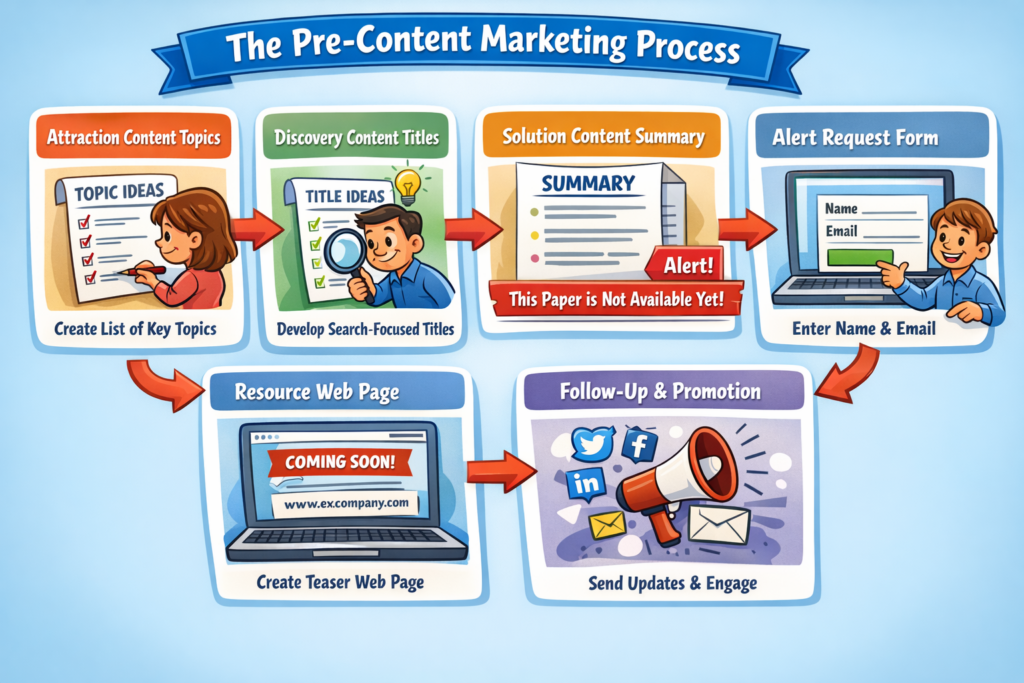
The pre-content marketing process begins by identifying high-value attraction topics your audience actively searches for, then developing discovery-focused titles using strong search, value, and motivator keywords. Next, short solution summaries are written to clearly define the buyer problem, highlight a compelling fact, outline the risks of inaction, and promise a solution. Each concept is published on a dedicated resource page labeled “Not Available Yet,” with a simple alert registration form to capture early interest. Registrants receive a follow-up message to gather insight and refine the resource. These pages are promoted over time across multiple media channels, and only the resources that generate sufficient demand are fully produced, published, and delivered—while low-interest topics are safely canceled with minimal cost or effort.
Attraction Content Topic List
Create a list of the 5-10 key topics (or more) your customers need and are searching for. existing and desired papers you want to publish.
Discovery Content Title
Identify key search, value and influence words related to the content value. Create title concepts that include key search words and phrases along with key motivator words.
Solution Content Summary
Create summary descriptions of the content and their solution value – 1 to 3 paragraphs max. In the first paragraph, the first line should be the problem statement – closely match what your audience wants help with. This should be followed by a shocking factoid – a surprising related information factoid or statistic that amplifies the reader’s emotional need. This is followed by 3 pain points (what happens if they do nothing). The first paragraph ends with a solution promise sentence – “this <resource> will help you to discover ways to…”.
“Not Available Yet” Alert Message
Include a statement below the description that informs the reader that the resource is not completed yet. After the summary, include this statement: “This Paper is Not Available Yet. If you would like to be alerted when it becomes available, enter your name and email below.”
Our tests have shown that 4x the number of people register for white papers when they are not available – fear factor. Note – this is a true shocking factoid!
Solution Resource Web Page
For each resource, create a web page on your company website or another site that is related to your resource topic (blog, magazine, association, etc). Each resource URL should include keywords that are separated by hyphens to allow the search engines and AI tools to easily separate the keywords. Include the name and email request on the white paper summary page or include a link to the alert registration form.
Alert Request Registration Form
Setup a alert request registration form which allows the reader to request to be informed when the resource becomes available. Only ask for the name and email. You can get additional qualifying information in followup emails. Adding any additional contact detail requirements (such as phone number, type of company, etc) is likely to reduce your submission rate by 80% or more.
Registration Followup
Rapidly respond to the submitter with a thank you for requesting the resource message between 1 to 5 days along with a request they tell you the top 1 to 3 things they are looking for in the resource. You can use these requests to help create a better resource and the communication you have with the person who registered for the resource will help to develop your relationship value (solution helper).
Pre-Content Resource Promotion
After you have created your content resource web page(s), you can publish many media posts with links to them over several months or years to keep your visitors and leads coming. To quickly create Tweets, Blog Posts, Discussion Topics, and other media posts, you can rewrite your title and summary into many formats, focus, and use alternative words and phrases.
Completed Content Publishing
After resources are created, alert the people who registered and offer to help them with additional questions they may have (be a solution coach).
Resource Content Cancellation
If you decide not to publish the resource, you can remove the web page. You can send messages to anyone who had registered for the cancelled media item informing them that the paper will not be completed and offer to directly help them with their information request. If your content has been online for several months or longer, very few people (probably none) will remember that they registered to receive an alert message for your paper.
If you want to learn more on how to setup and manage a pre-content marketing project or campaign, connect with me on Linkedin and lets chat – Linkedin.com/in/lharte/

About Lawrence Harte
Lawrence Harte is the publisher and editor in chief of iMarketing Magazine, a leading publication focused on data-driven, AI-enabled, and connected digital marketing. He is the author of more than 153 books on communications, media technology, and business strategy. Between 2005 and 2026, Mr. Harte interviewed more than 4,137 executives, technologists, and innovators across the media, marketing, and digital ecosystems. He is the co-founder of the Digital Marketing for Business Trade Show. He holds many degrees and certificates including an Executive MBA from Wake Forest University (1995) and a BSET from the University of the State of New York (1990).